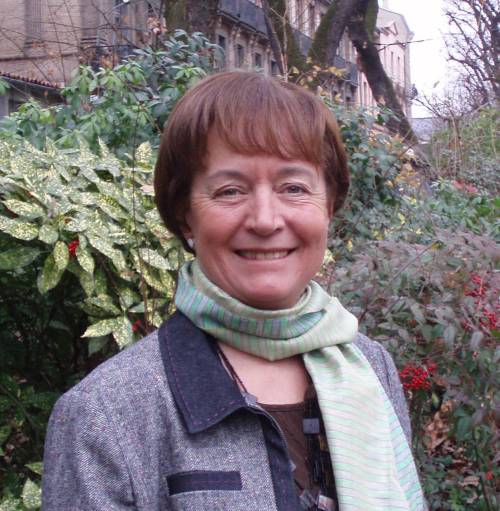
 Sylvie Vauclair, born March 7, 1946 in Saint-Germain-en-Laye, is a French astrophysicist.Institute for Research in Astrophysics and Planetology) and professor emeritus at Paul Sabatier University in Toulouse, where she taught for more than 30 years after teaching about ten years at Paris University 7.
She is an Honorary Member of University Institute of FranceMember of The Air and Space Academy and The Academy Europaea. She is Knight of the Legion of Honor, Officer in the National Order of Merit and Officer of Academic Palms.
|
The name Sylvie Vauclair was given by the International Astronomical Union to an asteroid of the main belt: 352333Sylvievauclair
|
After two theses led by Hubert Reeves and then by Evry Schatzman, his scientific work focused on the formation and evolution of the chemical elements that make up matter in the Universe: Sun, Stars, Primordial Universe. In recent years, she has been particularly interested in the asterosismology, i.e. the vibrations of stars, as well as extra-solar planetary systems (exoplanets). She wrote about 250 scientific articles in specialized journals and directed many theses.
Sylvie Vauclair was president of the French Society of Astronomy and AstrophysicsPresident of the Midi-Pyrénées section of the French Physical SocietyMember of the National Council of Universitiesmember of the High Scientific Committee of The Paris Observatorymember of many international committees, in particular European Commission, European Southern Observatory (ESO) and the Berne Space Institute (International Space Science Institute). Professor Paul Sabatier University of Toulouseshe has been responsible for many lessons, in particular the Master-Research « Astrophysics, Space Sciences and Planetology ».
Passionate about the sharing of knowledge and the evolution of knowledge over the centuries, in relation to the history of human societies, she has written many books (see bibliography section) and runs numerous courses and conferences at all levels, often for a very large audience. With extensive musical training, she participates in multidisciplinary meetings combining science, art, philosophy and poetry. She has published numerous articles in journals for readers « Non-initiated ». She is a member of the council of many cultural associations and events, the patron of many of them. She has been president of the jury of the International Festival of Scientific Film in Orsay, as well as other juries of cultural events. She was responsible for organizing the World Year of Astronomy for the Greater Southwest in 2009.
She participated in a large number of debates, documentaries and radio and television programmes on most major channels. Its actions and works were crowned by the ALPHA d'OR of SPACE (1998), the CERCLE AWARDS of OC (1999), the SCIENTIFIC BOOK PRICES of ORSAY (2002), the LACADEMIA AWARDS of OCCITANIA (2007), the GREAT AWARDS OF THE CITE OF SPACE (2009), the GREAT SCIENTIFIC BOOK PRICES OF THE GOURMETS OF LETTERS (2015)
Sources wikipedia and www.sylvievauclair.fr
The Word of Sylvie Vauclair, Astrophysician and Professor Emeritus at Paul Sabatier University – Marraine 2018
Human beings are scientists from birth. In his cradle, the little one needs to eat, to sleep, to be treated when he is sick, to feel love for his parents, but all this is not enough for him. It is essential for him to be able to discover the world, to try to understand it and to situate himself in relation to it. For this, he uses the five senses that nature has given him. He looks, he touches, he smells, he listens, and he sucks the toys he gets offered. Then, when he starts to move, he takes an interest in everything that surrounds, takes and studies the objects that are within his reach. Finally, when he starts talking, he asks « Why? », by asking all the questions that come to mind to better understand his environment, questions that parents often find difficult to answer.
It is often said that young people should be encouraged to think about science. I would say this differently: we must give them the opportunity to develop the scientific approach which is theirs from the moment of birth, without holding them back. This is exactly what the exposciences do, leaving young people free to develop their own subject, in the pleasure of research and discovery, the happiness of understanding and being able to share their approach with others, with the public. It is in this way that young people can then become responsible adults in the changing world that is ours today. I wish a great success at the Toulouse 2018 Exposcience!
Sylvie Vauclair